Showing posts with label Silmarlion. Show all posts

Saturday, March 7, 2026

Ancient World Fantasy

The most common default setting for a secondary world Fantasy is a Medieval Europe inspired setting, some Fantasy Anime might have a Medieval East Asia aesthetic. 

But settings besides the Middle Ages do exist. We have Space Fantasy or Futuristic Fantasy, the kinds of Fantasy that get confused for Sci-Fi. We have Gaslamp Fantasy which is the Fantasy counterpart to SteamPunk. And Urban Fantasy refers to stories set kind of in the modern world.  And of course settings inspired by the Ancient World also exist. 

But what I wanna talk about here is how Ancient World Fantasy so often defaults to the Bronze Age, at least in the Vibe they give off, they might be using Iron weapons but the Vibe is Bronze Age. From old Italian Sword and Sandal films, to the 90s Sam Raimi Hercules and Xena shows, the obscure 1991 OVA Majuu Senshi Luna Varga, the 2018 Isekai Anime The Master of Ragnarok & Blesser of Einherjar. And then the Fate/Grand Order Babylonia Anime also fits into this lineage. 

The Bronze Age is the largest age of Antiquity, it is about Two Thousand years from over 3300 to 1177 BC, Biblically that’s The Tower of Babel (or you could argue Tubal-Cain in Genesis 4) down to near the end of Judges. The thing is the sub ages that can obviously be divided into are not all that distinguished by these kinds of Fantasy Stories. Those Sword and Sandal films will mix and match the Heroic Age of Greek Mythology with Sumeria and Egypt's Old Kingdom will look the same as the New Kingdom. 

Exceptions exist, I own some of them, but none of those have made huge impacts on Pop Culture.  At most we could have Classical Antiquity references being meshed into an otherwise Bronze Age aesthetic like 300 or all the Rome stuff in Xena, Xena’s timeline will not ever make real world sense and that’s what’s fun about it. 

One of the key early Trope Codifiers of Ancient Secondary World Fantasy was Conan The Barbarian and other works of Robert E Howard.  Howard was to Ancient World Fantasy what Tolkien is to Medieval Europe Fantasy. And that includes how both were not strictly secondary worlds originally, they both technically set their stories in a prehistoric distant past of this world.  But they mark a key transition into modern Secondary World Fantasy because of how the detailed world building made their world seem distinct yet real in ways prior stories doing technically the same thing more vaguely like William Morris stories could not. 

And that's why Fantasy Stories were originally drawing inspiration from the less well documented periods of human history (that’s what the term “Dark Age” originally meant, a period we don’t know much about), and the Bronze age was once even less well documented then it is now. Only once the transition to full Secondary Worlds was complete did writers of Medieval Fantasy realize they could start moving upward into the High Middle Ages and Renaissance for inspiration. But why didn’t Ancient World fantasy do the same?  

Each type of Fantasy Setting began with writers who were to some extent romanticizing the period they are drawing inspiration from, the Fantasy stories with more cynical takes on those time periods came later in response to the stories that first popularized it. 

And in the modern world the kinds of people who romanticize Classical Antiquity do so in a way that is functionally mutually exclusive with telling stories where real Supernatural stuff happens. Classical Antiquity is romanticized by principally New Atheists/Reddit Atheists who pretend the values of rationalism and empiricism were more popular in ancient Greece and Rome then they actually were, that it was a Golden Age of Science and Reason destroyed by the rise of Abrahamic Religion. And when someone like this does want to write a Fantasy Story regardless, we see they still Romanticize the Post Enlightenment era more, like Philip Pullman. 

Now you may think “Christianity was born during Classical Antiquity so wouldn't Christians romanticize it?” but you'd be wrong. The world view of modern Right Wing especially High Church Christians is that Christianity was born into a broken world that needed fixing and the Medieval World was the product of Christianity fixing it.   Liberal Christians (especially Low Church Protestants) believe Christianity was born into a broken world and modern Liberal Democracy is the result of Christianity eventually slowly fixing it.  And a Leftist Christian believes Christianity was born into a Broken world and still hasn’t fixed it yet.  The point is that the context of The Gospel demands that Jesus wasn’t born into the best period of time to be alive Civilizationally speaking. The option I’ve been more willing to consider then most Christians is that there was value in the Hellenistic Civilization that was lost when it fell to the Romans, and the fall of the Hasmonean Kingdom was certainly lamentable, after all Jesus observed Hanukkah in John 10. Ultimately though I am a Leftist with Liberal characteristics.

Atheists however, not all Atheist but the really devout ones who build their personality on being Atheists, have a world view built on inverting the Catholic view and appropriating the Puritan view.

In The Hebrew Bible Israel at it's height as a Kingdom is an Iron Age history, perhaps the only Tribe in the world that sees the Iron Age as their Golden Age.  But Christians look at that age almost similar to how Atheists look at Classical Antiquity, Supernatural stuff happened, but rarely enough that it was always a notable Divine Intervention. And we Leftist and Liberal Christians view the Judges period as being when Israel actually operating closer to God's true intent. 

Another reason The Bronze Age is more popular than the Iron Age is because it has the quality of being what was Ancient History already to the people of Classical Antiquity.

But another factor is the Western Bias, every time I said "Classical Antiquity" both you and I were first and foremost thinking of the Greeks and Romans more than the Persians or Carthaginians or Parthians or Late Period Egypt or Kushites or the kingdoms of East Asia and Mesoamerica and certainly not the “Barbarians” of Western and Northern Europe.  And when we do we kind of think of them as being aesthetically still in the Bronze Age (which is kinda true for Egypt, they never entered the Iron Age). 

The plot twist I've been building to is that perhaps a different style of Ancient World Fantasy has been hiding in plain sight this whole time.  That Tolkien’s legendarium was actually more Ancient than Medieval all along but pop culture perception has just run with faulty assumptions. 

When early Rings of Power images started coming out I saw one person on Twitter not at all inclined to say nice things about Rings of Power say that at least its costume design is more inline with Tolkien’s actual intent then the Peter Jackson films. Peter Jackson’s costume design went all in on the High Middle Ages when the Third Age of Middle Earth really was Early Middle Ages at the latest. Literally the Norman Conquest is when Tolkien felt everything went wrong.  Eomer shares a name with a 5th century king of the Angles for a reason, the Rohirrim and Rhovanion are meant to be hypothetical ancestors of the pre-migration Anglo-Saxons. 

Even if the Third Age is Medieval, it’s not just Western Europe, Gondor is kind of Byzantium, the rump in South Eastern Europe of the fallen Empire of the West.

The First and Second Ages however are definitely Ancient, they are basically imagining that the Celts had a “Civilization” before the Greeks and Romans. And in so doing it results in Numenor feeling very Roman and Eregion feeling a little Athenian, and I would even call Mordor kind of Sparta how Anti-Spartan Athenians saw them. The Fall of Gondolin was partly based on Troy as many have written about before. 

And capturing all of that is part of why I love Rings of Power, especially season 2. 

Monday, January 22, 2024

Valarin could be based on Hebrew

Valarin is arguably the most mysterious of the languages that help define the world of Tolkien’s Legendarium. We don’t know nearly as much about it as we do the main Elvish Languages.  And the first question often is was some real world Language the inspiration? Quenya’s starting point was Finnish, Sindarin’s was Welsh and the Language of the Rohirrim is meant to be imaginable as an ancestor of Old English.  With Valarin however no one is certain which, if any, real world language we should look to.

Valarin is the native tongue of the Ainur, a group further subdivided between Valar and Maiar, beings that are essentially what Abrahamic religions call Angels.  Angel comes from the Greek Angelos used to translate the Hebrew Malak both words mean Messenger because serving as God’s messengers to humans is the function they are usually serving when they show up in The Bible but it's perhaps not what these beings would call themselves, nor is it the only term they’re ever called in The Bible.  Likewise Vala and Maia are Quenya names given to these beings by the Elves.

The assumption has long existed among many theologians that the Language of the Angels would have to be Hebrew or something very similar, after all the only two named Angels in Scripture have Hebrew names even when mentioned in the Greek New Testament books.  Today it may mainly be certain fringe sects of American Evangelical Fundamentalism most likely to make a big deal out of if that is the case or not, but it is historically not unique to them.  John Dee devised Enochian as a hypothetical Angelic Language basing it on Hebrew.  And I’m sure there have been Catholics (Tolkien’s denomination) who have agreed.

What little we know about Valarin in Tolkien’s Legendarium is in-universe filtered through the perspective of the Elves.  I imagine that even in Valinor communication between the Elves and Ainur usually involved the Ainur speaking Elvish rather than the other way around.  Nonetheless the Elves were exposed to some Valarin words and some Quenya words are said to be Valarin loan words.  However I really think we should not rule out that the Elves may have often misheard, mispronounced and misunderstood the meanings of the Valarin words that entered their vocabulary.  Plus some of it comes in-universe from people no longer in Valinor speculating ages later.

Consider how the known real world history of Hebrew names being transliterated into European languages by Christians includes such end results as Moshe becoming Moses, Slomoh becoming Solomon, Yeshua became Jesus and the four letter name YHWH having such varied interpretations as Yahweh and Jehovah (I personally view Yahuah as the correct form).

The first Valarin word I want to discuss is the name of Orome’s horse Nahar, now the Roman spelling of the Valarin original form is presented as Næχærra (the apparent X there is actually Chi a symbol for the -ch sound) but presenting the casual form as Nahar makes a possible Hebrew basis obvious.  Nahar resembles two Hebrew words due to there being two Hebrew letters that can become an H in English.  One is the Hebrew word for River but the other the KJV translated "Nostrils": or "Snorting" and in it the letter used for H is the letter that is also the Hebrew letter for -ch, and in both Job 39:19-20 and Jeremiah 8:16 it is associated with the sound a Horse makes.

The next Valarin word I want to discuss is machanaz (machanumaz being the plural) which is said to mean Authorities and is the root of a term for the Aratar the Eight highest ranked of the Valar.  The Hebrew word I think this could come from is machaneh which means company or camp or host and is used in Genesis 32:2 to refer to “God’s host”.  Also look at the -um being added to make it plural, that could come from Elves mishearing -im which is the most common Hebrew suffix to convey plurality.

Aman the Blessed Land the name of the Continent on which Valinor resides is a name Tolkien originally presented as coming from a Quenya name meaning Good but he later decided it was Valarin in origin.  Aman is also a Hebrew word that in the KJV is translated things like Assurance, Believed, Faithful, Nursed, Steadfast, Trusted and Trusty.

Ainu comes from the Valarin word Ayanuz. As a Quenya word Ainu means Holy One but that could be a meaning the Elves gave the name because they viewed the Aniur as Holy, or they named the concept of Holiness after these semi divine beings they interacted with.  Ayanuz could come from the Hebrew word Ayin meaning Eye (and it’s the name of the Hebrew letter this word begins with) or ayam which means Mighty and began with the same letter.   There is a good real world Proto Indo-European etymology for Aina the Quenya word for Holy, it might be the Elves connected this name to a phonetically similar word.

Honeyed Wine is the meaning of mirubhoze.  One Hebrew word for Wine is tiryowsh and the Hebrew word for Honey is dbash. Now this is more of a stretch then my prior examples but I still consider it plausible, perhaps as a Mondogreen form listening to a Valarin song.

Even the name of Arda is said to be Valarin in origin.  That name is related to many Germanic words for Earth including Earth itself but the Afrikaans Aarde is the closest.  But plenty of Semitic words for Earth happen to seem phonetically similar like the Hebrew Erets and the Arabic ‘ard.  However the stated Valarin name for Arda is Aþāraphelūn which is supposed to mean “appointed dwelling”.  Palon/Pelon is a Hebrew word from the root Palah meaning separate.  The Athara part could come from atar/atarah which means compass or crown conveying the idea of a circle.

Before I discuss any more confirmed Valarin words or names, I want to speculate on a few names designated Quenya but that could have involved Valarin loanwords that Tolkien never explicitly told us were.

Melkor is the name that is often referred to as the original name of the Legendarium’s Satan figure before he was given the obviously derogatory name Morgoth.  But Melkor is presented as a Quenya name that even it may not have been his original name, Melkor is said to mean “he who rises in might”.  In some Tolkien YouTube videos I’ve noticed when people quote older abandoned versions of the tales Melkor is often more simply Melko.  On Tolkien Gateway other early forms of the name are listed as Belcha, Melegor and Meleko and the meaning is simply “The Mighty One”. 

I can’t help but see a connection to the Hebrew word for King which is Melek and how the first King in The Bible is Nimrod the Mighty Hunter.  Examples in real world history of named derived in whole or in part from this word include Melchi and Melchior. 

The word Melek is associated with Satan first and foremost in Ezekiel 29 starting in verse 11 where the Melek of Tyre is a Cherub in contrast to the mere human Nagyim of Tyre in the prior verses.  I believe this passage is in part identifying Satan with Melqart/Melkart the Patron deity of Tyre who’s name is interpreted as meaning “King of the City”.  He’s also the “King of Babylon” in Isaiah 14 who desires to place his throne above the Most High, to “Rise in Might”. 

However the deity name Moloch is also just Melek with different vowel indicators and some scholars think those different vowel indicators came later and originally every reference to Moloch/Milcom was just the Hebrew word for King/Kings.  Moloch references include most of the Human Sacrifices documented in the Hebrew Bible which is why he’s sometimes viewed as the most Evil pagan god The Scripture references even more so than Baal.  But it’s also possible if Moloch was a distinct deity name at all it was just the Ammonite name for Hadad who the Canaanites called Baal and the Moabites called Chemosh.

The conception of Satan that Morgoth is based on isn’t actually Biblical, it’s founded upon layers of Extra-Biblical Fan Fiction culminating in John Milton’s Paradise Lost.  Now many today don’t know this but John Milton was actually a political radical of his time who argued in his nonfiction writings that the very concept of having a King other than God Himself is Idolatry.  Satan in Paradise Lost is a manifestation of that idea, the first and ultimate False King.  So a post Milton depiction of Satan being basically named King kind of fits.

The characterization of Melkor/Morgoth in the various First Age stories is that he begins mostly motivated by a desire to Dominate to Control to Rule.  In other words to be the God-King of Arda.

Of the two main names used for The Monotheistic God of Tolkien’s Legendarium, Iluvatar is the most straightforward having its real world etymology firmly in Quenya’s Finnish roots.  Eru however is very mysterious and I was indeed shocked to learn it’s NOT one of the names officially confirmed to be Valarin, it sure doesn’t seem even close to Finnish, Yksi is the Finnish word for One.  Speaking of Eru meaning The One, I personally want that to actually be an Elvish mistake.  In my opinion it is bad form for a Trinitarian to give God a name that mean The One and flat out heretical to name Him “He that is Alone”, calling your theological First Principal by such titles is an influence of Pythagoreanism and Platonism calling it The Monad.  The New Testament and Early Christians preferred Eis Theos and Mia Theos to Mono Theos.  Eis and Mias like the Hebrew Eched means one as in United or Unified not an Absolute Only One.

The phenomena of the sound represented by the letter L being mispronounced as an R is NOT in fact unique to Japanese or other East Asian Languages.  Back in my youth long before I got into any of the Weeb stuff I’m into now I always misheard the L in the middle of the word Colonel as an R, consistently no matter who said it, at first I was unable to recognize it in print because I’d heard it that way so consistently. [Update: Name Explain now has a video on Colonel.]

I’m bringing this up because coincidentally El the Hebrew word for God is one of a few Gaijin words that the Japanese tend to pronounce Eru, others include the Spanish definite article and the English name of the letter L.  Most times I’ve seen or heard Eru in Japanese media it’s been the Spanish reference like the title of the Anime El Cazador de la Bruja (The Hunter of The Witch) the first part of which gets pronounced Eru Kazado.  However there is a Visual Novel called You and Me and Her: A Love Story where a Cat is named Eru and the credits say Eru has the same voice actor as God.

So what I’m getting at is maybe Eru came from some Elf mishearing or mispronouncing El under the right circumstances.  Or a shortening of a mishearing or mispronouncing of Elah or Eloah or Elohim.

Yavanna seems to be the first of the Valar (going through them in Valaquenta order) whose name isn’t said to be Valarin in origin.  Yet I can’t help but notice how much it looks like a feminine form of Yavan, the Hebrew name for Greece.  The Strongs says the name is related to Yayin, another Hebrew word for Wine which fits the Fruit connection of Yavanna’s name.  I’m trying to think of reasons that it would culturally or religiously make sense to fan theorize that Primitive Greece descended from particular followers of Yavanna, I suppose the standard practices of Interpretatio graeca would identify Yavanna with Gaia, Cybele or Magna Mater, but even that feels like a bit of a stretch. [Update February 9th: I've looked into some theories about Dione and Dodona and now think she may work.]

There are other names that look instantly Hebrew when I look at them even though I can’t imagine how the name could in universe be Valarin in origin, like how Gilgalad reminds me of Gilgal and Beor is the name of the father of the first King of the Edomites in Genesis 36.  Any other writer of European style Fantasy I’d just chalk it up to how Biblical Names entered our vocabulary and this writer didn’t think about where they came from.  But Tolkien was specifically a Linguist first and foremost.  If he knowingly put Hebrew names in there he did so for a reason.

I’m going to cover some more confirmed Valarin in origin words now, but I’m growing less certain how to make them fit my Valarin=Hebrew hypothesis, everything above is the foundation of it.

The name of Varda comes from the Quenya root Barada which means Subline, Exalted or Lofty and is said to be a Valarin loan word.  Baalath is a Hebrew name derived from Baalah meaning Mistress or Lady.

Manawenuz is the Valarin name of Manwe and I can’t help but jump to connecting it to Manehem a Hebrew name that means Comforter and thus possibly the Hebrew concept behind the Paraclete of John and 1 John and is also a name a number of Jewish traditions have given to Messiah Ben David.  Now fully identifying Manwe with either Jesus or The Holy Spirit would be a type of Arianism which I don’t believe Tolkien was going for, the Finrod ap Andreth established that Eru himself will incarnate as a Human to bring about the final healing of Arda.  But you can still argue Manwe is typologically stewarding the Seat of Authority destined for the future Incarnate Eru.

Ulluboz as the proposed root of Ulmo I speculate could come from Alluwph a Hebrew word that is sometimes translated Captain.

Aule’s name is said to come from Valarin Aȝūlēz.  Ayal is a Hebrew word meaning strength.  

Nessa’s name is suggested to be Valarin according to Pengolodh.  There are two Hebrew words I considered since Hebrew has two letters for S.  The shin one would be Nasa which means to carry or bear something, and the Samek one would be Nacah which means Adventure, Prove or Try.

Aromez as the origin of Orome could be related to Arumah a Hebrew name derived from the root rumah which means height.  Or from ‘orem which means craftiness.

Atharaigas as a name for The Sun could have its roots first in again atar/atarah meaning compass/crown/circle and Ygiya meaning Labor or Work. 

Osse’s name could be related to Hosea, a Hebrew name that means deliverer.

Ezellochar could come from Ezel meaning departure and achar meaning next.  How that’s a fitting name for the location of the two trees I’m unsure.

Machananaskad likely begins with machaneh again since it is a name for the meeting place of the Aratar. The next part could be nashaq which means armed. 

Monday, April 30, 2018

Are modern Elves really that based on Tolkien's?

It's commonly said that Tolkien's Elves are the inspiration for most Elves in fantasy stories written since, in novels like the Dragonlance series, or Dungeons and Dragons and other Table Role Playing Games, which leads to Role Playing Video Games including JRPGs which in turn influences a lot of Anime, Manga, and Light Novels that then get adapted into Anime.

The thing is, these supposedly Tolkien like Elves seem to me to be.... demoted in terms of their importance to the Lore.  They're now just another one of many Human like Fantasy Races, not Humanity's other half.  They're Elves but they're not The Eldar.  Tolkien's Elves are meant to be kinda similar to what Humans might have been like if Adam hadn't fallen.  While in a lot of Anime they're basically just Cute Girls with pointy ears.

I suppose to some extent it's full circle, they're back to being more like the Ljósálfar of Norse Mythology.  Tolkien's Elves are largely a product of combining them with certain beliefs about the Fae/Tuatha De Dannan of Irish Mythology.  And some older Judeo-Christian conceptions of a hypothetical Pre-Adamic race (before compromising with Evolution turned hypothetical Pre-Adamic races into Cave Men and Ape Men).

I think the most interesting take on Elves in Anime would be No Game No Life, where I'm convinced they're an unflattering allegory for The United States.  The reason I relate to Nilvalen so much is because she's an Elf who hates her own country.  But as interesting as that is, it's not very Tolkien like.

Who I do feel are similar to Tolkien's Elves are some fantasy races not called Elves.  The Cetra in Final Fantasy VII.  How the Amazons were presented in the Wonder Woman and Justice League films of 2017.  There are others I think, but they escape my memory at the moment. 

What's Problematic is how Tolkien's Elves can come off as similar to the Aryans of the racist theosophical ideas that inspired Hitler and Himmler.  But that's why I'd like to see Fantasy races with a similar mystical gravitas be depicted with more ethnic variety.  You can already find a decent amount of Fan Art depicting some of Tolkien's characters as being less white then he probably envisioned.

Fortunately we're unsure what human ethnicity the Cetra would most resemble, we only ever see Aerith, who's only half Cetra, and briefly her mother in a flashback.  Westerners are inclined to see a Caucasian when we look at Aerith but the original Japanese audience might not have (Westerners have accused Anime characters of looking White when they were modeled after specific Japanese celebrities).

I've contemplated in any fantasy story I might write depicting the Ljósálfar as white looking but the Dökkálfar as Japanese looking and the Svartálfar as Nubian (or maybe swap the latter two).

Now Biblically I don't believe in any Pre-Adamic Race, I oppose the Gap Theory.  I've contemplated having the hypothetical Elves of any fictional mythology I'd create descend from Cain in order to deconstruct the assumption that descendants of Cain were inherently Evil.  The problem is it'd also be playing into the rhetoric of certain Racists to associate any descendants of Cain with Non-White especially African ethnic features.

I know for certain that if I ever made any fiction set in the Pre-Flood world I'd depict the tribes of Enosh Ben Seth (from whom came Enoch and Noah's Family) as looking Middle Eastern.

Saturday, September 24, 2016

Benevolent Dragons and Tolkien.

Tolkien's mythology as he wrote it being very Western had only Evil Dragons.

Contrary to how some may make it sound it's not solely because of The Bible the West tends to view Dragons/Serpents as Evil (in fact there is overlooked Biblical support for good Dragons). It comes also from Ophion, Hydra and Ketos of Greek Mythology, Jormungander and Niohoggr of Norse Mythology, and the Grendles and Dragons of Beowulf.

Eastern Mythology usually has Dragons as Benevolent, though Japan has some evil ones too. Many are Dragon Kings who rule the seas.

Since we readers and writers of Fan Fiction are always interested in expanding and diversifying Tolkien's world, (as detailed as he was he did leave plenty to the imagination). I've contemplated how hypothetically possible it could be to put Benevolent Dragons in Arda.

The origins of the Dragons that served Morgoth are not directly explained, a common theory is the originals were fallen Maia who Morgoth then bred. That Glarung seems to be equal in rank to both Sauron and Gothmog, (both Maia, one a leader of other Maia), suggests to me he's probably also a Maia. Which has me thinking that if an evil Maia could take that form, there is no reason a good Maia couldn't take a similar form.

So perhaps there could be Benevolent Dragons known in the far Eastern lands of Arda, to the East of anything seen on LOTR's maps. Perhaps something like Valoo from The Legend of Zelda: The Wind Waker. In one scene Valoo and the Rito pretty much serve the same function as the Eagles.

Someone already wrote one Fan Fiction for that concept.


If you're curious about my Biblical statement. For Starters Jesus used the Brazen Serpent that Moses raised up in the wilderness as a symbol of himself in John 3.   The Hebrew word Seraph is used in that account where it is made a synonym for Nahash (Serpent in Genesis 3), in fact the word "serpent" may come from Seraph ultimately.  Isaiah described Seraphim circling the Throne of Yahuah, leading many to think of the term as a synonym for Cherubim. Also in Job, God speaks of Behemoth and Leviathan as creations he's very proud of.  All these words can also be linked to Satan (except Behemoth), but Satan was one of 5 Cherubim, the other 4 didn't fall.

When comparing Ezekiel's descriptions of the Cherubim with John's in Revelation 4.  It seems like each one is particularly associated with one of the 4 types of animals, yet at the same time they each have traits of each, Eagle's wings, cloven hoofs, human eyes and bodies like lions.  If Satan is the 5th Cherub and the Serpent/Dragon one, then the other 4 could also have some serpentine association.  And it was in this form that Isaiah saw them.

Sunday, July 17, 2016

Here is my real problem with the Wonder Woman movie being set during WWI rather then WWII

Others talk about how it seems like an obvious ploy to not seem like it's ripping off Captain America.  Others talk about how WWII is such an important part of this genre's history so it's a shame to miss out on the opportunity.  Others talk about how it might be a choice made because it overlaps with the Suffragettes, and whether that is good or bad.  But while I have moderate opinions on those things, my real issue is something far more real.

WWII is the ONLY War of the 20th Century where you can make a reasonable argument that one side was good and the other bad.  And the 21st Century has been even worse.  Now I've spent some time talking about how I question the traditional simplistic view of WWII, like my last Captain America post.  But at the end of the day there is no questioning that the Nazis were horrible and some good came from stopping them.

WWI is the Polar Opposite, WWII helped inspire the War of the Ring, but WWI inspired the Kinslayings of the Silmarilion.

No side has any real moral superiority in how WWI started, it was basically a rematch of the Franco-Prussian war.  It was something that many saw as an inevitable outcome of the irrational hatred European nations had of each other for decades before it started.  Not to mention the exact same Japan that was an Axis power was an Ally in WWI, the Emperor did change but it was the same Imperialist policy.  And this war factored into them expanding their Empire including their subjugation of Korea.  From the Pacific Theater's POV you could argue both were the same war.

My fellow Americans have convinced themselves that at least we had a just cause for entering that war, by painting the Lusitania the same as Pearl Harbor or 9/11.  But I view the Lusitania's sinking the same as I do the Main or the Gulf of Tonkin.

So the Wonder Woman movie will do 1 of 3 things.

1. WWI is just a framing device and not really what the conflict Diana is resolving is about at all.  Which will just make the decision seem pointless.

2. It will be a morally complicated story.  But I don't want that for the origin story, especially for the first big Screen Wonder Woman, since she's such a Feminist Icon I simply want to see her defeating the patriarchy.  The villains I want to have depth and maybe be redeemable like her Golden Age stories, but I don't want to question that Diana is on the right side.  Save the more ambiguous stories for the Sequels.

3. Or they will treat it the same as a WWII Superhero story anyway, German accents equal bad guys, ect.  And I simply won't be able to buy that.  When reading fiction written at the time in allied countries I can accept it, (Sherlock Holmes and Arsene Lupin both served as spies in fictional versions of that war,) because I get being caught up in a patriotic fervor at the time.  I remember how a younger more naive me reacted to 9/11.

But looking back on it now with a century of hindsight.  Part of me honestly thinks the world might have been better off if the Central Powers had won.  Hitler could never have risen without the trauma of Germany's defeat.  Britain and France wouldn't have redrawn the Map of the Middle East the horrible way they did.  And maybe Japan's imperialism would have been thwarted sooner.  But I suppose being an American saying that might inspire some to accuse me of treason.

Of course preventing the War from happening altogether would be best.  

Wednesday, September 23, 2015

The Holy Grail and The Silmarils

First I want to admit up front that parts of this post will be very clearly drawing on a Jason Colavito article and the Tolkien Gateway Wiki.

Most people don't know that the Holy Grail of medieval Arthurian Lore was not originally universally identified as the Cup of the Last Support, or linked to the Crucifixion.  It's possible origins in the Cauldrons of Celtic mythologies will be a topic I'll possibly discus in the future.

The earliest Medieval Grail Romance of Chretien de Troyes describes it as a dish that contains a communion wafer.  So if it had a Eucharist connection at all (which I'm not sure there was) it was probably to the Bread not the Wine.

Wolfram von Eschenbach’s Parzival (c. 1205 AD) which first describes the Grail in Book 9, describes it as a Stone of heavenly origin.

Graham Hancock in his book The Sign and The Seal makes much of this Grail being a stone rather then a Cup, and speculates that Wolfram's Grail is really code for the Ark being in Ethiopia, he then argues that Zazamanc is based on the Auxumite Kingdom.  I haven't read Parzival in it's entirety so I don't know, but I don't think I've seen anyone but Hancock say Zazamanc is where the Grail is in that work.  (Rereading it I remembered the gist was he saw the Gail Maiden marrying Feirefiz was a coded way of saying it went to Zazamanc).  None the less Hancock's theory has remained interesting enough to me that it influenced the previous Arthurian Legend post I did on this blog.

Bob Cornuke also argues for the Ark being in Ethiopia but coming there a different way then the Menelik Legend, and unlike Hancock does so as a Bible Believing Christian, but doesn't bring the Grail theory into it that I can recall.  I don't agree with any of Hancock's other alternative history theories, but The Sign and The Seal I highly recommend, it's a fun well researched book even if you disagree.  I agree with all Cornuke's theories but his latest Temple one.

Back to the subject at hand, Hancock does mention the Heavenly origin of the Grail aspect of Wolfram, he goes into a theory about the Tablets in the Ark actually being one of many Meteorites that fell to Earth and became objects of worship (like Acts 19:35, or the Kaaba in Mecca). .But he doesn't reveal the full story of Wolfram's description.
“They who took no part in the conflict, when Lucifer would fight with Three-in-One, those angels were cast forth from Heaven’s height. To the earth they came, at God’s bidding, and that wondrous stone did tend” (translation: Jesse L. Weston)
 It’s possible, given the attribution of the Grail myth to Arabic texts, that Wolfram had in mind the alleged alchemical power of the Emerald Tablet, also from Arabic texts, when describing the Holy Grail as essentially the Philosopher’s Stone.

This, in turn, ties in with a legendary set of songs supposedly composed by bards which included Wolfram, called the Wartburgkrieg, composed at least fifty years later. In the surviving accounts, one of the poems told how Lucifer’s crown had a stone that fell to earth thanks to Michael:
“Sixty thousand angels who wished to drive God from heaven had a crown made for Lucifer. When the archangel Michael tore this from Lucifer’s head, a stone sprang loose from it, and that stone is the Grail” (translation: William Ashton Ellis). 
This, in turn derived from the medieval myth that Venus, the Morning Star, was the jewel from Lucifer’s crown. Many writers fail to distinguish between this poem and Parzival, and some writers mistakenly attribute these lines to Parzival.

In 1832, “San Marte” (Albert Schulz) produced a loose paraphrase of Wolfram in which he interpolated the Wartburgkrieg text without indicating the distinction. He falsely makes Wolfram say....
"The holy Grail is a stone of the most wondrous and mysterious kind. A number of angels having remained neutral and inactive during the battle of Lucifer and the rebel angels against God and the faithful heavenly hosts, after Lucifer’s fall they were condemned by God to support this stone, which had dropped from Lucifer’s crown, hovering between Heaven and Earth till the hour of redemption of sinful mankind. Then they brought it to Earth, and, formed into a costly vessel, it served for the dish out of which Christ ate the Pascal lamb, and in which Joseph of Arimathea received the Saviour’s blood." (translation: William Ashton Ellis) 
Wolfram’s version stops at “support this stone.” Everything after is Schulz’s text. Victorian authors repeated this rather than bother to read the original (which, being medieval German they could not), and thus Wolfram became retroactively the originator of the claim of Lucifer’s crown. Modern people know the story because of glosses and notes on Wagner, using these Victorian sources, interpolated into editions of Parsifal.

Tolkien I'm certain however had a better handle on German then Victorian writers, but could still have been influenced by all of this.  And given his interests and goals in creating his mythology, it makes sense he'd draw on Germanic Gail lore over the predominantly French Grail lore that came to revolve around Lancelot and Galahad.

In The Silmarilion, The Silmarils are three Jewels forged by Feanor to contain the Light of the Two Trees of Valinor.  After the Trees were destroyed by Morgoth formally known as Melkor they became all that remained of the Light, and they fell into Morgoth's possession who had them placed in his massive Crown.

Many Wars were fought over the Silmarils.  Eventually one was taken from Morgoth's Crown by Luthien and Beren, it inevitably entered the possession of their descendant Elwing.  Elwing married Earendil (name means Evening Star, Tolkien took it form the Norse Aurvandil) son of Tour and Idril, and eventually her Silmaril became the Jewel of his ship Vingilot, which was granted by the Valar the ability to fly though the Heavens.

In Tolkien's Cosmology, Venus is the Star of Earendil, (because Venus is also known as the Evening Star as well as the Morning Star), which is defined as the Light of The Silmaril.  In Greek Heosphorus/Eophorus (the name used in the Septuagint of Isaiah 14) is the Morning Star and Hesperus the Evening Star, later Greco-Roman writers like Cicero became aware the two were the same star.

I suppose you could view Elwing as being in the role of the Grail Maiden.

The other two Silmarils were eventually taken by the Sons of Feanor after Morgoth fell but led to their deaths.  One was cast into The Earth (leading to debatable theories of it being the Arkenstone) and the other into The Sea, where I'd be very interested in possibility of Fan Fiction based on it being found by Captain Nemo and the Nautilus.  I can't be the first to think of that idea?

So the gist is, I think it's highly probable this obscure esoteric alternate Grail tradition partly helped inspire Tolkien.

Monday, June 15, 2015

The changing of Arda to a round world

After Arda became round at the destruction of Numenor and the removal of Valinor.  The New Lands appear on the other side of the world.

In the sense that Arda is roughly analogous to the real world, the New Lands are thought of a The Americas.

It is often speculated that the New Lands was previously The Land of The Sun, where the Sun rested during the night when Arda was flat.  I think that is valid but I want to add something.

When Valinor was removed I don't think the actual continent, Aman, was fully removed.  It's mystical unmarred quality was removed as well as the Aniur and Elves who lived there, and it's cities and buildings.  But I think the land itself remained.

I think when Arda became round the Land of the Sun in the East and Aman in the west came together to become the new lands.  With Aman roughly analogues to North America and the Land of The Sun roughly analogous to South America.

And The Dark Land would be Australia.

Saturday, May 16, 2015

Tolkien would have wanted his works to inspire Fan Fiction

I don't know where to find the quote now, but I'm pretty sure he had said he wanted in time other writers and artists to add to his mythology.  He knew full well no great mythology is formed entirely from the mind of only one person.  And I include in that both adding to the continuity and creating alternate continuities.

As massive as what he left us is, there is also much room to expand, even without continuing the story past the reign of Aragorn's son.  And if you do go past that the options are endless.

I think he would have wanted people with different backgrounds and experiences and perspectives then him to explore Arda in ways he couldn't.  So yes I think that includes women writers adding a female perspective.  Both further developing the female characters he already provided and creating more of them.  That is part of my defense of how lacking his handling of women was.

I think there is room even to expand Arda beyond just Middle-Earth, Numenor and Beleriand, and explore other less western (white) civilizations.  The Southorns and Easterlings get a bad wrap as seemingly just pawns of Morgoth and Sauron.  But Tolkien did leave more then enough hints that their being in that situation is not really their fault.  I love Faramir's speech at the end of disc one of The Two Towers extended edition.  In the book Sam said it, but I think that's one of the things the movies improved, Tolkien had described Faramir as the most like himself, and I see those words as coming from Tolkien's experience as a WWI solider.

I think it's also plausible to create all new Civilizations for Arda.  Both outside Middle Earth and maybe even within it.  During the second age we know next to nothing about the humans who lived in Middle Earth rather then Numenor.  Then there is the fact that the lands of Middle Earth did exist during the First Age, but the story of the First Age is entirely further west.  Why not invent some matriarchal Amazon like tribes for Arda, both within Middle Earth and without.  Some Edain Amazons who could make sense coming from an offshoot of Haleth's tribe, and some others too.

And the Dwarves (who had 7 clans but we only really ever see one) are equally as open.  The Dwarves seem far less likely to have ever had a matriarchal tribe, but the feminine side of the Dwarves is still entirely open for new writers.

Now it may seem difficult to believe a devout prudish Catholic like Tolkien would ever be Ok with Homosexuality being explored in his mythology.  But he also talked about Applicability, that a story should be interpreted beyond the Author's intent, even in conflict with it.

And you know what, I think it's telling that Tolkien never condemned Homosexuality at any point in his Legendarium (Lewis did with the Hardcaslte character in The Hideous Strength).  In-spite of how G rated his writing was when it came to Sex, he did address sex acts he viewed as wrong.  Eol and Ar-Pharazon are both Rapists in at least one version of their tales.

And Incest is explored, most famously with The Children of Hurin.  But what most annoys me about Tolkien's sexual morality is how harsh he is even to relationships between First Cousins.  The Bible not only never condemns it but even encourages it to an extent.  For the most part being grossed out by Cousin relationships is entirely modern, or Victorian in origin perhaps.  But Tolkien not only codifies it as wrong in Elvish law, but has it at the root of Meaglin becoming the Elvish Benedict Arnold.

So that he considered Same-Sex love less worth condemning then Cousin love, is interesting.  Tolkien also enjoyed a Lesbian Nurse Story.

Everyone has talked endlessly about the things in Tolkien that can be interpreted as male Homoerotisism.  But since Tolkien never passes the Bechel Test, actual relationships between women are virtually non existent.  So we have to look elsewhere for an excuse to interpret a character as Lesbian.

Tolkien may not have been aware of it, but it is now well known that Virginity in the ancient mythologies Tolkien drew on was often code for Lesbianism.  The most popular Tolkien character to see as possibly Lesbian by virtue of her seeming aversion to men is Tar-Ancalmine.  Unfortunately she seems to make a very problematic stereotype whatever orientation you give her.

The top two women in Tolkien I like to interpret as Monosexually Lesbian are Haleth and Tar-Telperien.  Both were leaders of their people who made a point of never being married.

Haleth as an early First Age human I don't even visualize as a Medieval person.  The Human tribes during the First Age I see as Ancient, but not Greeco-Roman Ancient, more like the Ancient pre-civilized Celtic and German/Norse tribes.  Haleth however seems to me like exactly the kind of woman who would wind up being a lover of Artemis.  Since I see some of Artemis in Nessa, I wind up shipping them together.  But there is also room to invent for her a human lover from her tribe, or have her meet an Elf.  A human from another tribe seems unlikely as I think she was always pretty far away from them.

Tar-Telperien, I have seen two people in the Fandom community already say she is Asexual in their head canon.  That is an equally valid interpretation from what little we are told about her.  But I really want to see a High Fantasy story about a Lesbian Queen, with a lover probably from a lower class.  Possibly drawing some inspiration from Berenice and Mesopotamia (free cookie if you know what I'm referencing).  And as far as room for that in Tolkien goes, Tar-Telperien is the best option.

All three Queens of Numenor get a bad wrap.  I feel like Tar-Telperien is the easiest to defend.  Her condemnation is entirely in her foreign policy.  Crap was going on in Middle Earth between Sauron and The Elves, and she choose to stay out of it.  In real life that is exactly the foreign policy I prefer as a former Ron Paul supporter, The U.S. should stay out of wars fought on other Continents.  It's hard to apply that to a fantasy setting where one of the Geo-Political entities is a literal Fallen Angel.  And I'm sure Tolkien had the WWII era American Isolationists in mind when he wrote characters like this.  But I for one will not condemn her for refusing to take her people to a war that did not really involve them.

She is also notable for being the only Ruling Queen who's known to have had a brother.  Speculation on that has been done elsewhere.  What I note here is the fact that her brother's son became her successor, and we do not know a name or identity for the mother of that son.  I think it's possible that if Tar-Telperien was exclusively Homosexual, but had a lover who was Bi/Pansexual, or at least more open to male-female intercourse for the purpose of reproduction then she was.  I could see her marrying her lover to her brother.

I do indeed consider the possibly of actual legal Gay Marriage in Arda unlikely, For the Elves Hetero-Intercourse and Marriage are the same thing.  We've seen in Fantasy and maybe History also examples of something like the above suggested arrangement with men.  A man in a royal gay male paring marrying his lover's sister.   Like Renly and Loras on Game of Thrones.

The Tolkien women who have loved men could certainly still be Bi.  But there is one more character I want to discus who's Sexuality is entirely up for debate.

Nienor Niniel, daughter of Hurin and sister of Turn Turambar.  Her relationship with her brother came about from the dragon Glaurung's manipulation of events, an argument can be made it tells us nothing about her actual Sexual Orientation.

You may be thinking "all he did it seems was wipe her memory?".  The key thing I think in Tolkien's mind was that their ignorance of their relationship to each other caused their natural sibling bond to be misinterpreted as romantic.  It didn't at all happen simply because she thought Turambar was Hot.

I found one Fan Fiction once were Niniel had a romantic relationship with Nellas before she went to search for Turin.  Then she survives her jump into the water, Nellas tracks her down and they raise the baby together.

Update:I'd like to thank Dawn Felagund for identifying the Quote I mentioned.
http://dawnfelagund.tumblr.com/post/119237448828/jaredmithrandir-olorin-tolkien-would-have-wanted

"I would draw some of the great tales in fullness, and leave many only placed in the scheme, and sketched. The cycles should be linked to a majestic whole, and yet leave scope for other minds and hands, wielding paint and music and drama. Absurd."

Another additional note. On my connecting Nessa to Artemis, It is notable that in the oldest versions Tolkien wrote she wasn't Tulkas wife yet, that was a separate Aniur.

Wednesday, December 17, 2014

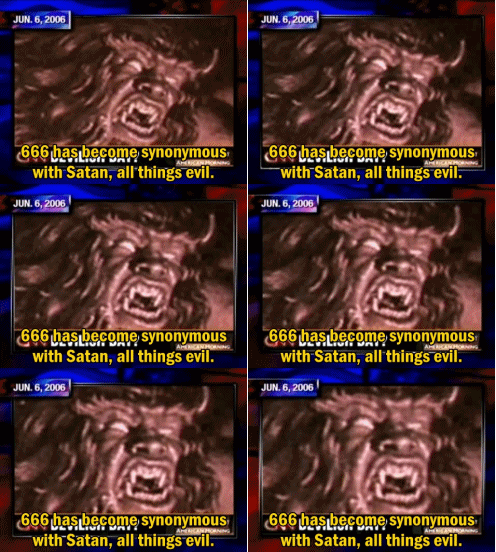
Get your facts straight, CNN


I can't find this video on Youtube, it was hilarious.

Update!!!
Finally found the video online
http://thecolbertreport.cc.com/videos/krcfjp/balrog

I'll see if I can Embed it here
<div style="background-color:#000000;width:520px;"><div style="padding:4px;"><iframe src="http://media.mtvnservices.com/embed/mgid:arc:video:colbertnation.com:015014d8-ed01-11e0-aca6-0026b9414f30" width="512" height="288" frameborder="0"></iframe><p style="text-align:left;background-color:#FFFFFF;padding:4px;margin-top:4px;margin-bottom:0px;font-family:Arial, Helvetica, sans-serif;font-size:12px;"><b><a href="http://thecolbertreport.cc.com/">The Colbert Report</a></b><br/>Get More: <a href="http://thecolbertreport.cc.com/full-episodes">Colbert Report Full Episodes</a>,<a href="https://www.facebook.com/thecolbertreport">The Colbert Report on Facebook</a>,<a href="http://thecolbertreport.cc.com/videos">Video Archive</a></p></div></div>